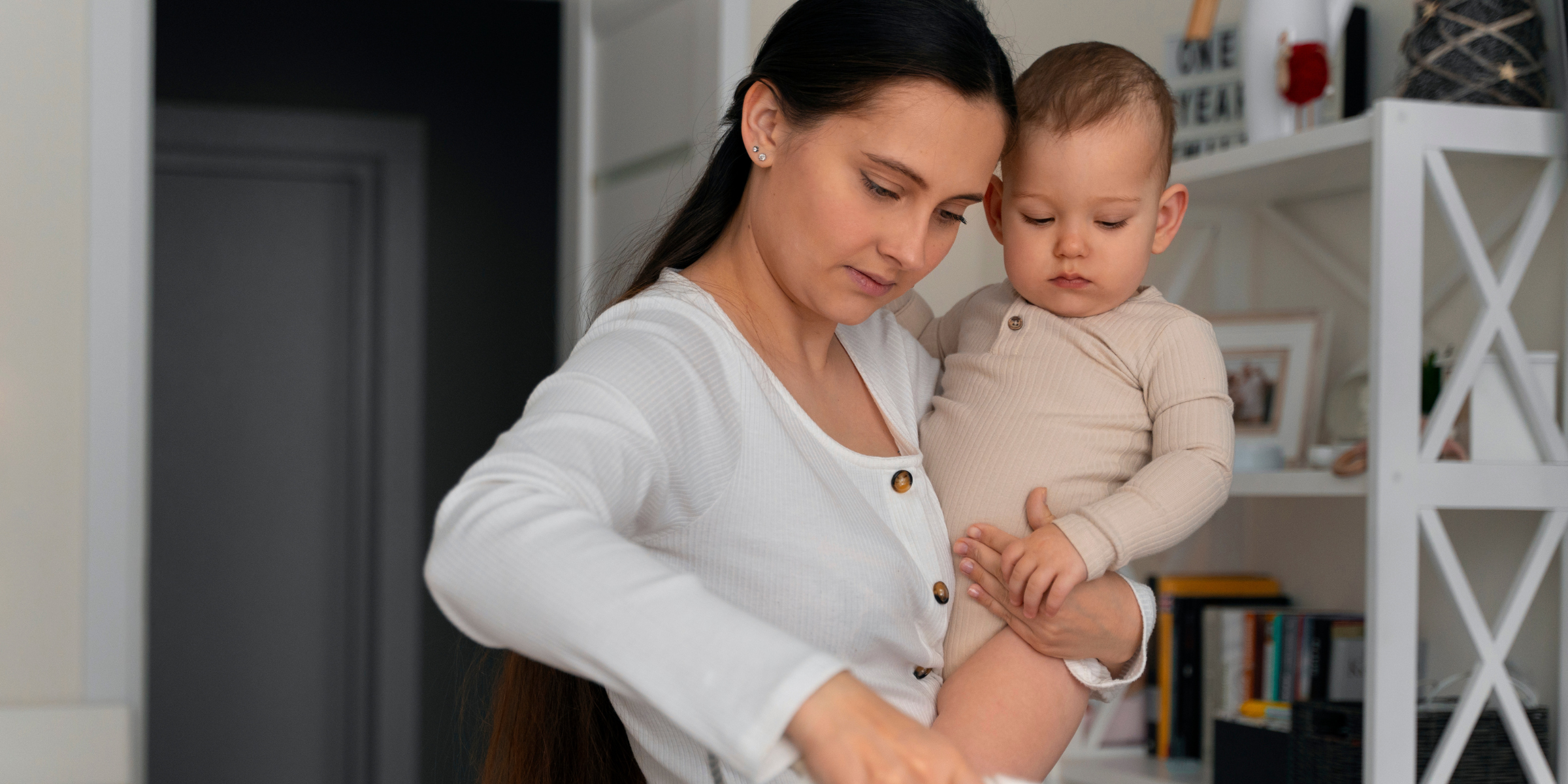
I expected a quick grocery run with my fussy one-year-old. Then a teenager mocked his cries, stepped closer to our cart, and did something that left the entire aisle silent.
My name is Amber, and Saturday grocery runs had become one of those routines I barely thought about anymore.
Before Mason was born, I could get through the supermarket in half an hour. I had a list, a route, and enough patience to compare prices without feeling rushed.
Motherhood had changed that.
Now every trip depended on the mood of a one-year-old.
That Saturday, Mason was buckled into the little seat built into the front of the cart.
He had been fussy almost from the moment we walked through the automatic doors.
He was teething, tired, and crying on and off no matter what I tried.
I handed him his favorite toy.
He threw it onto the floor.
I picked it up, wiped it on my shirt, and handed it back.
He threw it again.
"Okay," I murmured. "We're not doing that all afternoon."
For about 30 seconds, he seemed to agree.
Then he started crying again.
A few shoppers glanced our way as I moved through the aisles.
Most gave me that familiar sympathetic smile parents give each other.
One older woman even leaned toward Mason and whispered, "Those teeth are giving you trouble, huh?"
Mason stared at her with wet eyes.
Then he started chewing on the edge of his sleeve.
"Definitely," I said.
She laughed softly and continued down the aisle.
Little moments like that usually helped.
Being out with a crying baby could make me painfully aware of every person around me.
I knew his crying was irritating. It was irritating to me too, and I loved him more than anything.
Still, Mason wasn't misbehaving.
He was a baby.
I kept moving.
Milk. Yogurt. Eggs. Cheese.
Then we could pay and go home.
By the time I reached the dairy section, Mason had worked himself into another miserable little fit.
His cheeks were pink, and tears clung to his eyelashes.
"I know, sweetheart," I told him quietly.
I rubbed his back.
"We're almost finished."
That was when I heard laughter.
At first, I didn't realize it had anything to do with us.
A teenage boy, maybe 16, was standing near the dairy section with his friends, and he started loudly mimicking Mason's crying in an exaggerated, whiny voice for his friends to enjoy.
I looked over.
The boy was watching Mason.
There was no mistaking it.
He pulled a dramatic face and made another fake crying noise.
One of the boys beside him nearly doubled over laughing.
My first instinct was irritation.
My second was to ignore them.
Teenagers could be immature.
I remembered being 16.
Sometimes you laughed because your friends were laughing.
Sometimes you said stupid things because you wanted attention.
I didn't want an argument.
More importantly, I didn't want Mason stuck in the middle of one.
So I kept my tone light and polite.
"He's just a baby," I said, smiling slightly. "It happens. No need to make fun of him."
I expected that to end it.
Maybe he'd roll his eyes.
Maybe his friends would lose interest.
Instead, the teenager looked delighted that I had responded.
That only made him laugh harder.
"Maybe something's wrong with him," he said, grinning at his friends. "Like, defective or something."
Something inside me changed instantly.
I could tolerate someone being annoyed by crying.
I could even tolerate immature jokes.
But hearing someone describe my son like he was a broken product made every protective instinct in me flare at once.
I felt my whole body go tense.
"Don't talk about my son like that," I said, my voice sharper now.
The laughter around him faded slightly.
For a second, I thought he had finally realized he'd crossed a line.
He stepped closer to the cart instead of backing off, looking down at Mason with a smirk.
I moved one hand toward the cart handle.
There was something about the way he looked at Mason that made me uneasy.
It wasn't just teasing anymore.
He seemed to enjoy knowing he had upset me.
Mason sniffled and reached toward me.
I wanted to pick him up.
At the same time, I didn't want to make some dramatic movement that would encourage the teenager.
His friends were still watching.
None of them told him to stop.
One looked uncomfortable, but he stayed silent.
The teenager glanced toward the refrigerated shelf beside him.
Then he looked back at Mason.
"Maybe he just needs to cool off a little."
For half a second, I didn't understand what he meant.
Then his hand moved.
Before I could react, he grabbed a small bottle of milk off the shelf, opened it, and poured it straight over my son's head.
Everything seemed to stop.
I stood there completely speechless, milk dripping off Mason's face as he wailed even harder.
It ran through his hair.
It soaked the shoulders of his little shirt.
Drops landed on the cart and splattered onto the floor.
Mason squeezed his eyes shut and screamed.
My shopping list slipped from my hand.
"Mason!"
I grabbed the bottle away and shoved it onto the nearest shelf.
My hands shook as I unbuckled him.
"It's okay. Mommy's here."
But my voice didn't sound convincing.
I pulled him against my chest and wiped milk from his eyes with my sleeve.
He buried his face against me, crying so hard that his tiny body trembled.
For one awful moment, I couldn't even process what had happened.
A teenager had deliberately poured milk over a one-year-old baby.
Not by accident.
Not because he stumbled.
He had looked directly at me, made a joke, opened the bottle, and done it.
He was still standing there.
His smirk had weakened.
Maybe he had expected another angry sentence.
Maybe he had expected his friends to laugh harder.
They weren't laughing now.
One stared at the floor.
Another took a step backward.
My shock was quickly turning into anger.
I wanted to yell.
I wanted to demand a manager.
I wanted his parents called.
Most of all, I wanted to understand what kind of 16-year-old thought humiliating a crying baby was funny.
I opened my mouth.
Then I noticed the teenager's expression change.
He wasn't looking at me anymore.
His eyes had shifted past my shoulder.
The color seemed to drain from his face.
His friends went quiet.
That's when I saw a man walking up quickly behind the boy, and something in his expression told me this teenager's day was about to change completely.
The man never took his eyes off the teenager.
And I had absolutely no idea what was about to happen next.
The man stopped a few feet behind the teenager.
For a moment, nobody said anything.
Mason was still crying against my chest. I could feel milk soaking through the front of my shirt where his wet hair pressed against me.
The teenager looked like he wanted to disappear.
The man stared at him.
"Connor," he said quietly.
That was all.
But something about the way he said the name made the boy straighten immediately.
"Dad."
I looked from Connor to the man and tightened my hold on Mason.
Connor's father glanced at my son.
Then he noticed the milk dripping from Mason's hair and clothes.
His expression changed.
"What happened?"
Connor shoved his hands into his pockets.
"Nothing."
One of his friends looked away.
His father stepped closer.
"Do not lie to me."
Connor's jaw tightened.
I couldn't stay silent.
"Your son poured milk over my baby."
The man's eyes snapped toward me.
I expected disbelief.
Maybe defensiveness.
Parents could become protective when someone accused their children of doing something terrible.
Instead, his face went completely still.
"He did what?"
"He poured milk over my son's head."
Connor finally spoke.
"He was crying."
I stared at him.
Connor shrugged weakly.
"It was annoying."
His father's face hardened.
"He's one year old."
Connor said nothing.
The man looked at Mason again.
Mason had stopped screaming, but he was still sobbing in short, exhausted bursts.
His little fingers were wrapped around my shirt.
The man swallowed.
Then he faced his son.
"Apologize."
"Dad."
"Now."
Connor glanced at his friends.
That seemed to matter more to him than anything else.
He looked embarrassed.
He should have been.
"Sorry," he muttered.
His father shook his head.
"No."
Connor frowned.
"What?"
The boy stayed silent.
"Look at her and apologize properly."
Connor slowly raised his eyes.
I could see the anger in his face now.
Not remorse.
He hated being corrected in front of his friends.
"I'm sorry," he said.
His father waited.
Connor exhaled sharply.
"I'm sorry I poured milk on your kid."
The words sounded forced.
Still, I nodded.
"I hope you understand why that wasn't okay."
Connor looked away again.
His father turned toward his friends.
"You boys can go."
They disappeared down the aisle almost immediately.
Connor watched them leave.
"Dad, come on."
His father ignored him.
Instead, he looked at me.
His voice had changed.
There was no anger in it now.
Only embarrassment.
"I don't expect that apology to fix what he did."
"It doesn't," I admitted.
He looked down at the puddle of milk on the floor.
Then back at Mason.
"Is your baby okay?"
"I think so. He's scared."
The man nodded.
Connor scoffed quietly.
His father heard him.
He turned.
"Give me your phone."
Connor froze.
"What?"
"No."
The man's expression didn't change.
"Give it to me."
Connor pulled the phone from his pocket and slapped it into his father's hand.
His father took it.
"You're grounded."
It sounded nervous.
"For this?"
"Yeah, for this."
"You've got to be kidding me."
"I'm not."
Connor's face reddened.
His father stepped closer.
"No. It was humiliation."
Connor stopped talking.
His father pointed toward Mason.
"You saw someone smaller than you. Someone who couldn't defend himself. You decided that made him an easy target."
His father raised a hand.
"I'm still talking."
The boy went quiet.
"You embarrassed a mother. You frightened a baby. You did it because your friends were watching."
Connor's eyes dropped.
For the first time, I saw something besides arrogance.
Shame.
It didn't erase what he had done.
But it was there.
His father looked at me again.
"My name is Nathan."
The name sounded familiar.
I couldn't place it immediately.
Then I remembered.
His name was on signs around town.
He owned several local businesses.
I had driven past one of them that morning.
Nathan seemed to notice that I recognized him.
He looked uncomfortable.
"Yes," he said. "That Nathan."
Connor stared at the floor.
Suddenly, the teenager's confidence made more sense.
Maybe he had grown up believing his father's name could protect him.
Nathan looked at his son.
"You work at the warehouse after school starting Monday."
Connor's head shot up.
"What?"
"You heard me."
"I have soccer."
"Dad!"
"You'll work until you've paid for the damaged groceries, the cleaning, and anything else this woman needs replaced."
I shook my head.
"You don't have to pay me."
Nathan looked at me.
"I know."
"This isn't about what I have to do."
Connor looked furious.
Nathan continued.
"It's about what he has to do."
Connor's voice cracked.
"You're ruining everything over one stupid joke."
That made me speak before I could stop myself.
"It wasn't a joke."
Connor looked at me.
I shifted Mason higher against my shoulder.
"A joke at someone's expense is only funny if they're laughing too."
"My son couldn't understand why a stranger was hurting him. He just knew he was scared."
Connor's face changed.
He looked at Mason properly for the first time.
Not as an annoyance.
Not as something to impress his friends with.
Mason had finally gone quiet.
His cheek rested against me.
Connor's shoulders lowered.
"I didn't think he'd get that scared."
Nathan answered before I could.
Connor looked at him.
"You didn't think."
A store employee arrived with paper towels and asked whether we needed help.
Nathan explained what had happened.
He didn't minimize it.
He didn't call it horseplay.
He didn't call it a misunderstanding.
"My son poured milk on her baby," he said.
The employee looked horrified.
Nathan paid for the opened bottle and asked whether there was somewhere private where I could clean Mason up.
A manager led me to the employee restroom.
I washed Mason's hair with warm water in the sink.
He whimpered when I touched his head.
That nearly broke me.
Once he was clean, I wrapped him in the spare sweatshirt I kept in his diaper bag.
When I came back out, Nathan and Connor were still there.
Connor was holding a mop.
Not because anything was funny.
The sight was simply unexpected.
Nathan stood beside him.
Connor cleaned every drop of milk from the floor.
When he finished, he walked over to me.
His face was different now.
Smaller somehow.
Less certain.
"I'm sorry," he said.
This time, there were no friends around.
No audience.
No smirk.
I studied him for a second.
"Thank you."
He nodded.
Then he looked at Mason.
"I'm sorry, little guy."
Connor gave a small, uncomfortable smile.
Mason buried his face against my chest.
Nathan put a hand on his son's shoulder.
"We're leaving."
Before they walked away, Nathan turned back.
"Just Amber."
He nodded.
"Amber. I'm sorry you had to deal with this."
I looked at Connor.
"So am I."
"But maybe he'll remember it."
Connor didn't argue.
They left together.
I stood there for a while after they were gone.
I had expected shouting.
Maybe even a fight.
What shocked me was something quieter.
Nathan hadn't protected his son's pride.
He had protected the lesson.
On the drive home, Mason fell asleep before we reached the second traffic light.
I kept glancing at him in the mirror.
His hair was still damp.
His little face looked peaceful again.
I thought about Connor.
I still disliked what he had done.
Part of me probably always would.
But I also remembered the change in his face when he finally understood that Mason had been afraid.
Sometimes people learn empathy because someone explains it gently.
Sometimes they learn it because life stops them in their tracks.
That afternoon, Connor's father did exactly that.
And I hoped it stayed with him long after the smell of spilled milk was gone.
So here is the real question: When your child hurts someone who cannot defend themselves, do you protect them from the consequences, or teach them the lesson they may never forget?
Enjoyed this story? Here's another one for you: I thought I was finally getting the family I'd waited years to find. Then, moments before I married Connor, his daughter brought me something that made every late-night excuse and uneasy glance mean something else. By the time I understood why, I couldn't go through with the wedding.